Heterogeneous inference serving across three GPU vendors with llm-d








Most production inference clusters today are single-vendor because that is often the simplest way to configure and operate a cluster.
That is starting to change. Procurement cycles bring new generations alongside older ones, supply planning spans multiple accelerator options, and cost/performance profiles differ by workload. Real production fleets are accumulating heterogeneity whether or not the architecture planned for it.
This is an opportunity to unlock real value: different accelerator classes can be matched to workload requirements, stranded capacity gets reclaimed, and operators gain more flexibility in capacity planning. The case is stronger still for sovereign and on-premise deployments, where data residency, regulatory alignment, and the long-term economics of high-volume inference make local fleet optimization especially important.
Making that work in practice is a non-trivial systems problem. Each accelerator stack brings its own optimized drivers, firmware, container images, runtime settings, and attention kernels. A coherent serving layer needs to preserve those platform-specific optimizations while still giving operators one control plane for routing, observability, and policy.
Setup
To evaluate llm-d on a heterogeneous environment, we ran experiments on the NxtGen sovereign cloud's mixed GPU environment, with the following accelerator pools within a single OpenShift AI cluster:
| Pool | Hardware | Count |
|---|---|---|
| Vendor A | 2 nodes, each with 2 GPUs | 4 |
| Vendor B | 1 node with 8 GPUs | 8 |
| Vendor C | 1 node with 8 GPUs | 8 |
We use anonymized labels to keep the focus on the serving-layer behavior: how llm-d routes the same workload across the accelerator pools available in this test environment. The pools differ in generation, memory capacity, runtime characteristics, and expected per-GPU performance, so the results should be read as routing-policy comparisons within each pool and across the combined fleet.
All nodes are connected over a shared 100 G RoCE network. We pinned each vLLM replica to a single accelerator card (TP = 1) to maximize the number of independent serving instances and exercise the routing layer.
Models served:
ibm-granite/granite-4.1-8b— 8 B parameter, decoder-only dense transformer modelsarvamai/sarvam-30b— 30 B MoE, Indic-multilingual model
The workload is the prefill-heavy shared_prefix_synthetic from inference-perf: a long shared system prompt + short question + decode-tolerant output (~7.2K input tokens + 1K output tokens). This matches production RAG, chat, and citizen-services traffic profiles where prefix-cache routing is most beneficial.
What this benchmark shows
This benchmark evaluates llm-d as a routing and control-plane layer over a mixed accelerator fleet. It does not compare accelerator vendors directly. Instead, it asks whether a cache-aware, saturation-aware router can make single-vendor and heterogeneous pools behave like one inference service, using the same vLLM pods for both the llm-d run and the Kubernetes round-robin baseline within each pool.
The results are most relevant to operators who already have mixed capacity: sovereign cloud teams, enterprise AI platform teams, on-prem clusters, and organizations with staggered hardware refresh cycles. For these teams, the question is not a standalone accelerator ranking; it is how to route production traffic across the fleet they actually operate.
Prefix-aware caching
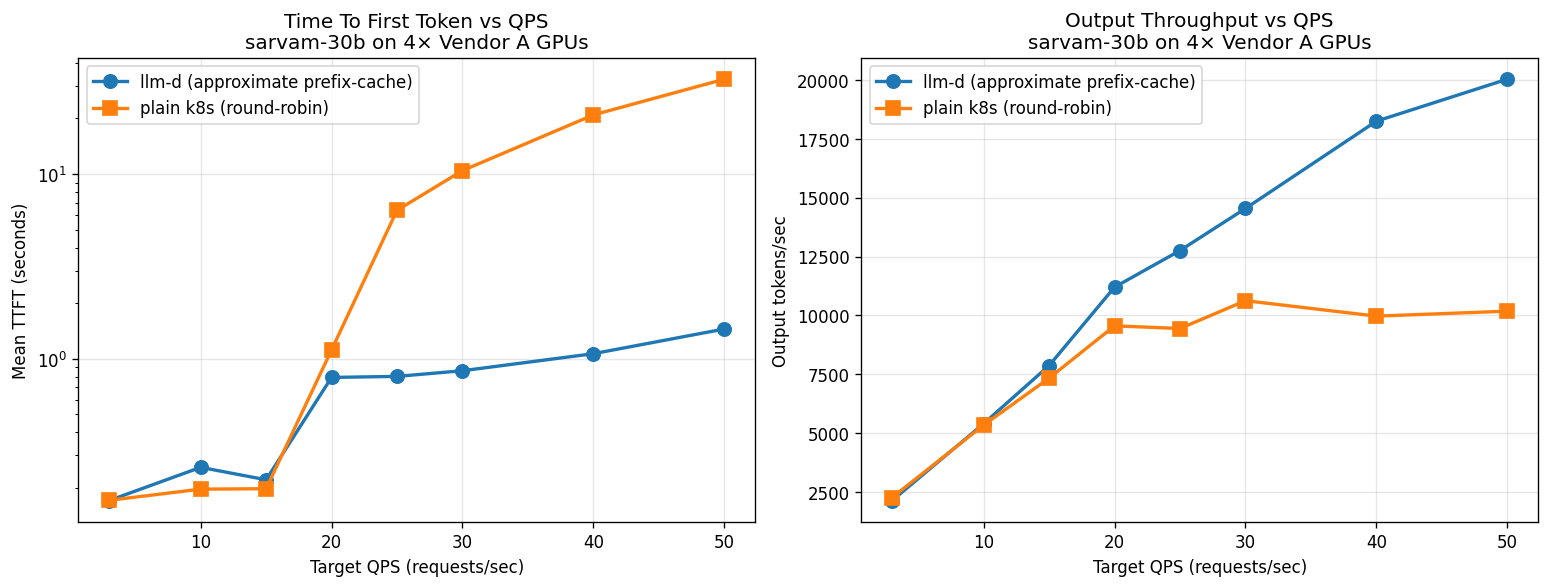
We deployed llm-d v0.7.0 with prefix-cache-aware routing in two flavours, picked per-model rather than per-pool: granite-4.1-8b runs against the precise prefix-cache scorer (tokenizer-backed, exact prefix matching), and sarvam-30b runs against the approximate prefix-cache scorer (xxhash over raw prompt bytes, no tokenizer required). The precise scorer needs a tokenizer, but sarvam's custom HF code requires trust_remote_code=True — a flag the v0.8.0 llm-d-router images does not pass through the UDS tokenizer sidecar. The hash-based approximate scorer bridges that gap.
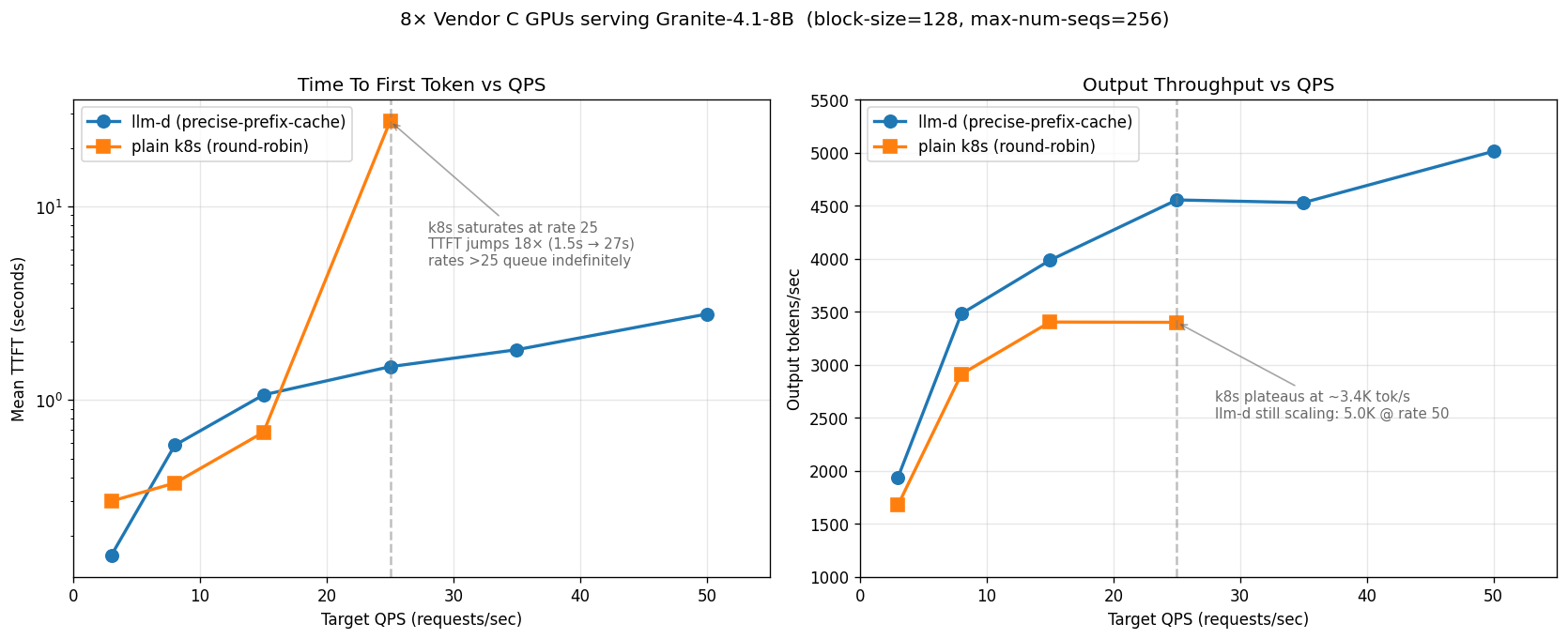
Each vendor's pods are deployed as a separate Helm release in the same namespace; only the nodeSelector and a small set of vendor-specific tuning flags (e.g. Vendor C's --block-size 128, --max-num-seqs 256, VLLM_BUILD pin) vary between the inference pool deployments. All pods carry the same selector labels and register with a single InferencePool maintained by llm-d's router. For the baseline, we use a ClusterIP service over the same set of pods to drive Kubernetes round-robin scheduling. Within each pool, the llm-d and baseline runs use the same pods, vLLM image, and serving flags; only the routing layer differs.
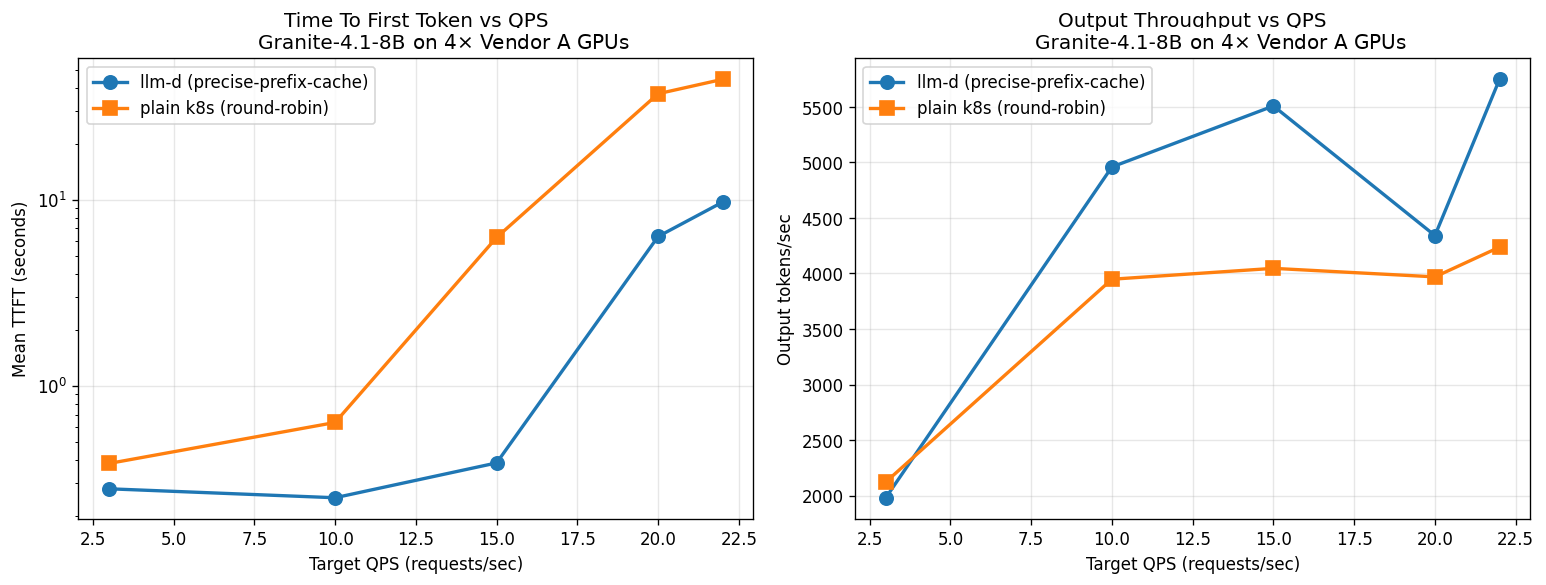
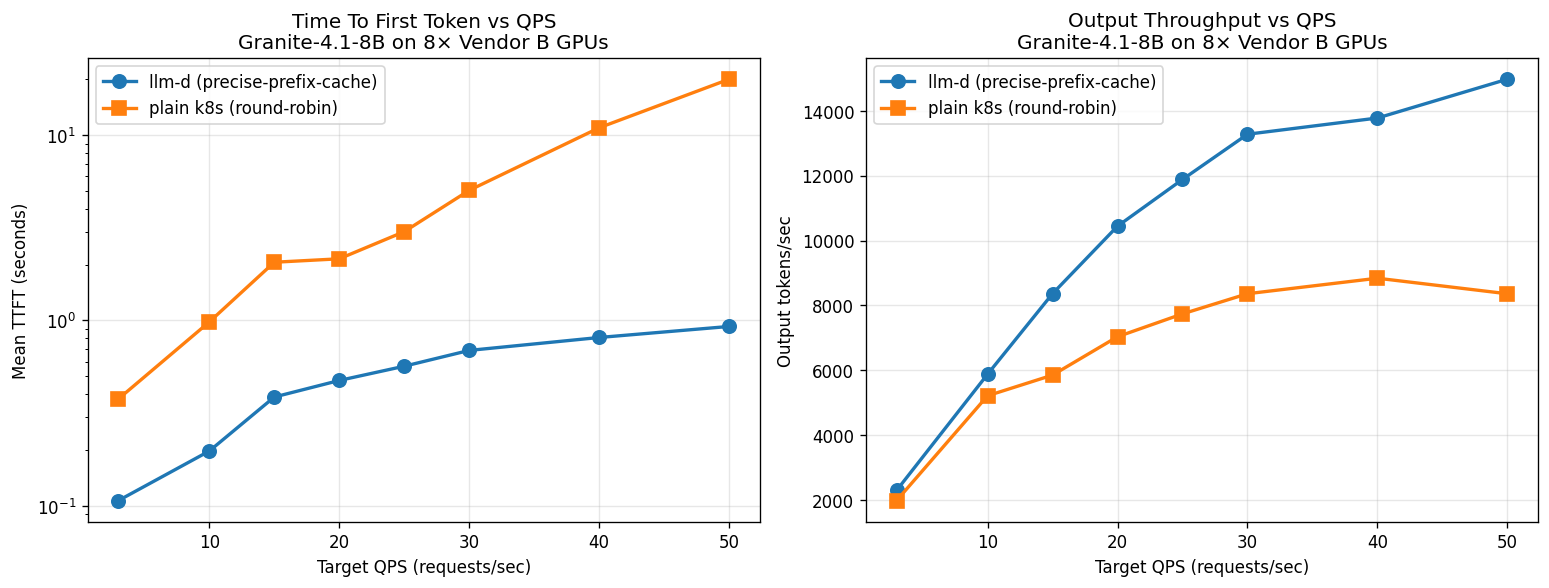
Across every pool we tested — single-vendor (A-only, B-only, C-only) and heterogeneous (A+B, A+B+C) — llm-d's prefix-cache-aware routing improved throughput and time-to-first-token (TTFT) compared with the k8s round-robin baseline. The improvement grows with pool size and heterogeneity.
| Pool | Pods | Model | Throughput improvement (llm-d vs k8s) | TTFT reduction |
|---|---|---|---|---|
| Vendor A only | 4 GPUs | granite-4.1-8b | +25–36% | 16× |
| Vendor A only | 4 GPUs | sarvam-30b | 2× | 22× |
| Vendor B only | 8 GPUs | granite-4.1-8b | +79% | 21× |
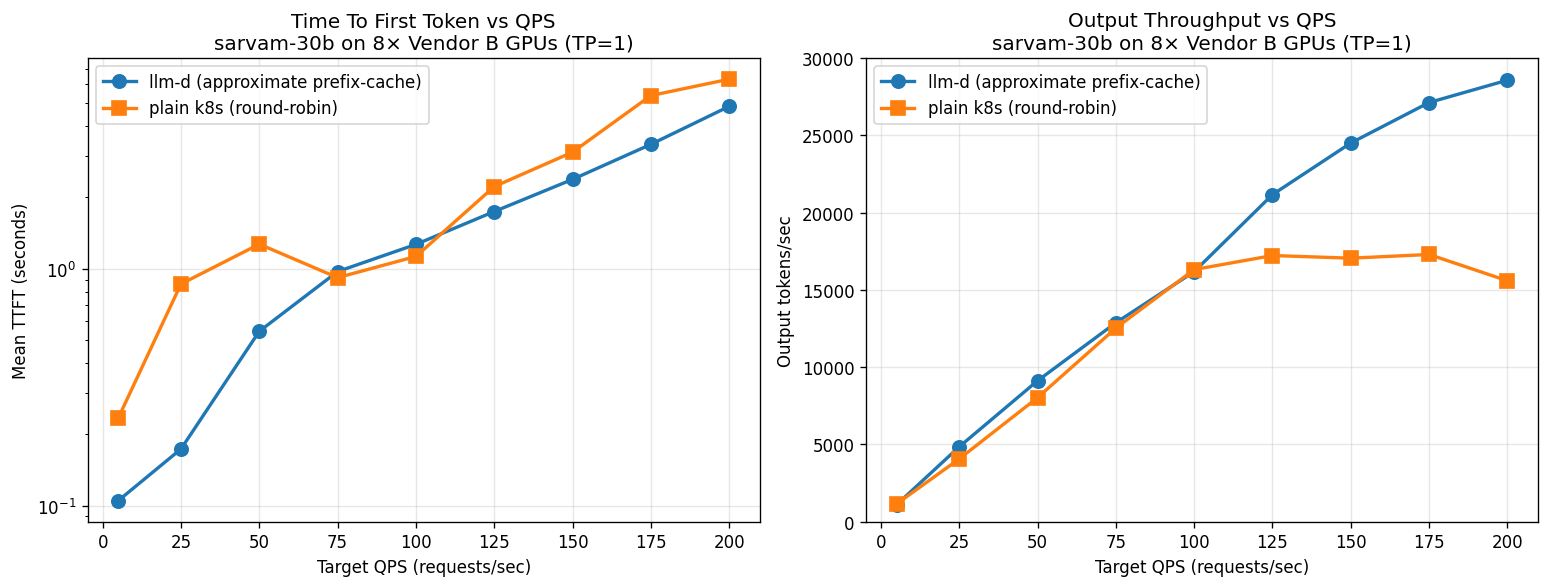
| Vendor B only | 8 GPUs | sarvam-30b | +83% @ 200 qps (28.6 K vs 15.6 K out tok/s) | 5× |
| Vendor C only | 8 GPUs | granite-4.1-8b | +34% | 18× |
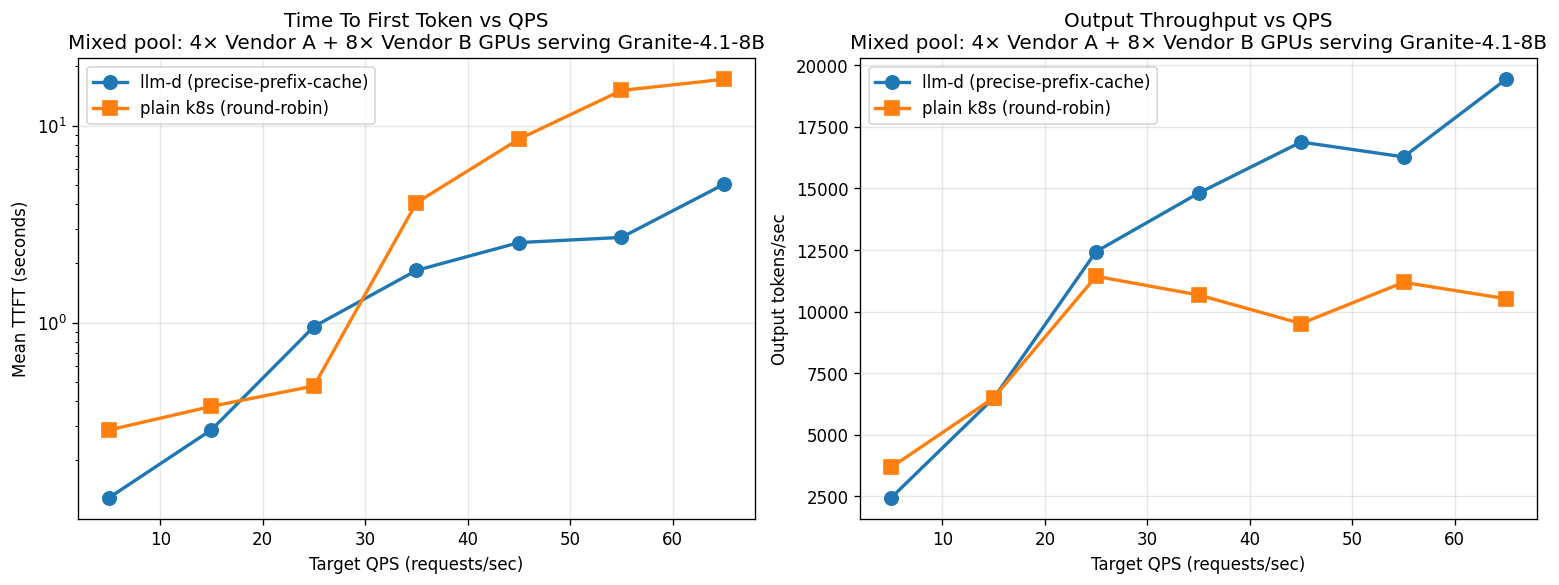
| Vendor A + B | 12 GPUs | granite-4.1-8b | +85% (19.4 K vs 10–11 K) | 3.4–5.6× |
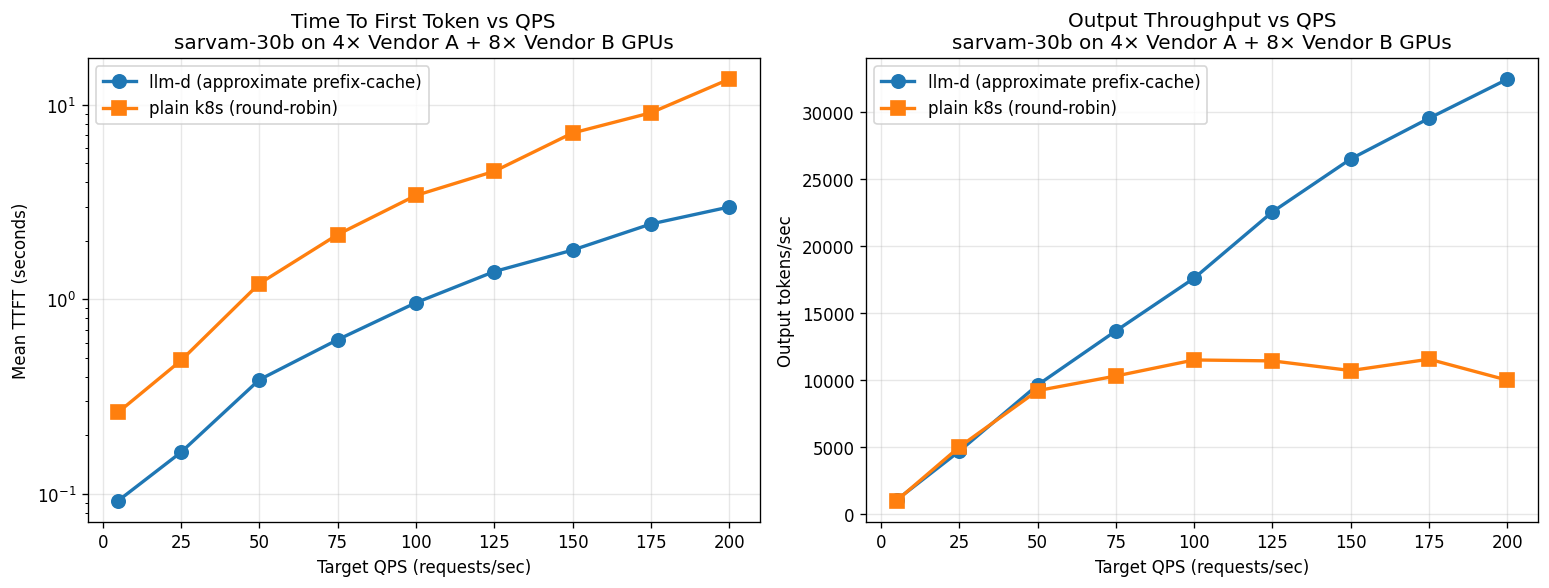
| Vendor A + B | 12 GPUs | sarvam-30b | ~3× @ 200 qps | 2.85–4.54× |
| Vendor A + B + C | 20 GPUs | granite-4.1-8b | +91% @ 85 qps | 5.4× |
Why heterogeneous pools benefit from llm-d: k8s round-robin spreads requests evenly regardless of current pod capacity, so lower-capacity or saturated pods can accumulate queue depth and reduce aggregate throughput. llm-d's prefix-cache-aware EPP accounts for saturation and concentrates cache hits on warm pods, so heterogeneous capacity can be used more effectively.
shared_prefix_synthetic is a favourable regime for prefix-cache routing: all requests share the same long system prompt, so cache hit rate on llm-d approaches 100% once a prefix is warm on a pod. Results are strongest for workloads with high prefix reuse; gains can vary with prefix diversity.
Single-vendor pools — granite-4.1-8b
We start with the per-vendor baselines so the heterogeneous results below have a reference point. All runs use ~7.2K ISL + 1K OSL.
4× Vendor A GPUs. llm-d improves TTFT by up to 16× compared to k8s, and output throughput by 25–36%.
8× Vendor B GPUs. llm-d delivers up to 21× better TTFT and +79% throughput vs k8s round-robin on this Vendor B-only granite deployment.
8× Vendor C GPUs. At saturation (rate 25), llm-d delivers +34% throughput and ~18× better TTFT compared with the k8s round-robin baseline.
Single-vendor pools — sarvam-30b (multilingual MoE)
4× Vendor A GPUs. llm-d delivers 2× the throughput and 22× better TTFT. The k8s round-robin baseline reaches saturation between rate 15-25, while llm-d continues to scale across that range.
8× Vendor B GPUs. k8s throughput plateaus at ~17 K out tok/s (peak at rate 175) and declines to 15.6 K at rate 200, while llm-d keeps scaling to 28.6 K out tok/s at rate 200 — +83% over k8s at the same rate (or +65% peak-vs-peak). TTFT-wise llm-d is up to 5× faster at lower rates.
We did not include sarvam-30b results on Vendor C because the model integration and the tested runtime image depended on different vLLM API versions: sarvam's hotpatch_vllm.py pins vllm==0.15.0, while the tested Vendor C image was based on vLLM 0.16. We plan to revisit with the llm-d community once the version mismatch is resolved.
Heterogeneous pool results
Vendor A + B (12 pods, granite-4.1-8b). While k8s throughput plateaus at 10–11 K tok/s, llm-d goes up to 19.4 K — 85% higher throughput. TTFT-wise llm-d is 3.4–5.6× faster at higher rates.
Vendor A + B (12 pods, sarvam-30b). llm-d brings down TTFT by 2.85–4.54× and increases throughput by close to 3× at rate 200. The mixed pool shows the largest gain for this model because round-robin is least aligned with heterogeneous capacity, while llm-d's prefix-aware routing adapts to the observed serving state.
Vendor A + B + C (20 pods, granite-4.1-8b). The 20-pod 3-vendor (A + B + C) pool delivers 14.2 K out tok/s peak with llm-d vs 9.6 K with k8s round-robin. k8s saturates at rate 25 and declines to 7.5 K at rate 85 (queue depth dominates) — llm-d delivers +91% throughput at the same load. TTFT at rate 85: llm-d 6.8 s, k8s 36.4 s (5.4× better).
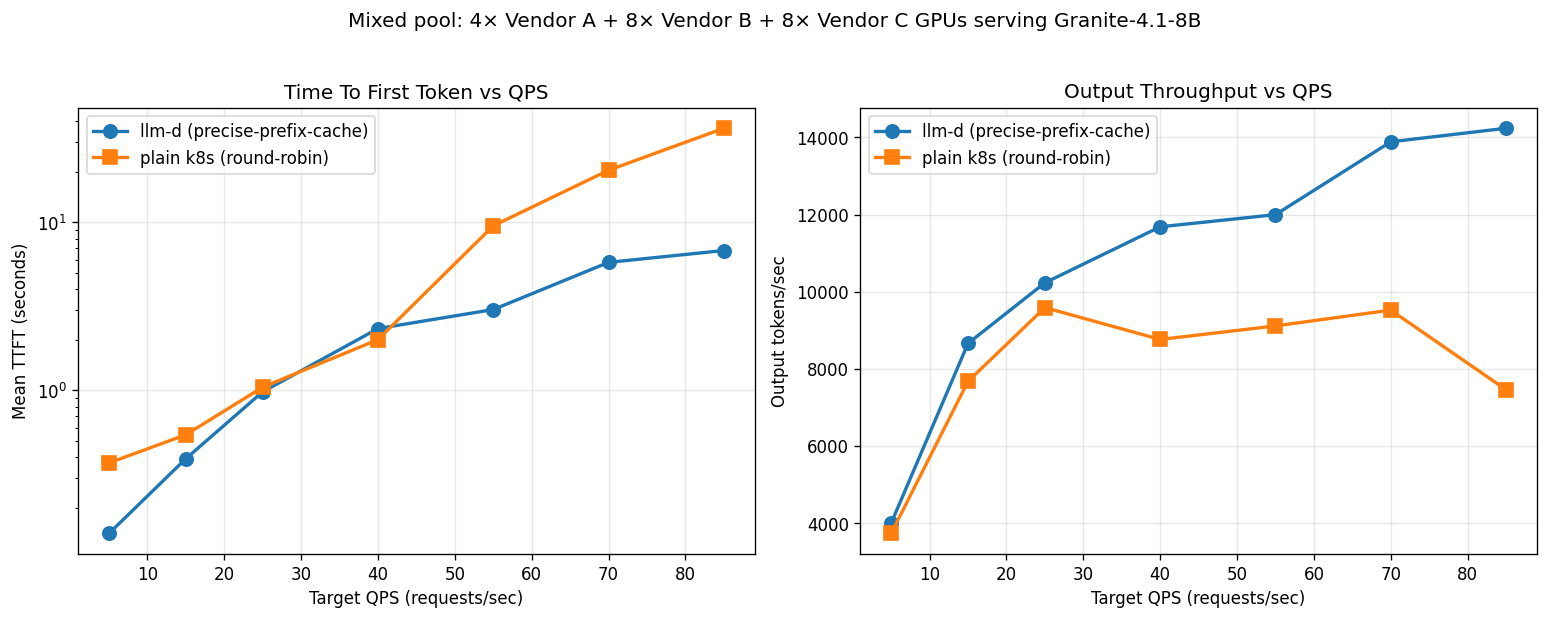
The rate ladder stopped at 85 QPS because the single-replica EPP became CPU-bound, not because the pool saturated. EPP work scales with pod_count × QPS, so the 20-pod 3-vendor (A + B + C) pool hits the CPU ceiling well before a smaller single-vendor pool at the same QPS. Per-pod throughput here sums to ~25 K, so the true pool ceiling is likely higher; EPP horizontal scaling (replicas: 1 → 2) or a higher CPU limit would unblock it further.
Takeaway
Heterogeneous serving is useful when the routing layer understands more than endpoint count. In this workload, llm-d improves throughput and TTFT by routing with prefix-cache locality and saturation signals, while preserving the platform-specific settings each accelerator pool needs. That is the practical value for mixed fleets: operators can expose diverse capacity through one inference pool and let policy, cache state, and load shape placement decisions.
What's next
Cross-accelerator P/D disaggregation. We plan to take heterogeneous inference to the next level by enabling prefill and decode to run on mixed accelerator types within the same cluster — for example, routing compute-heavy prefill to one vendor's nodes and memory-bandwidth-intensive decode to another's (or vice versa), based on where each phase runs most efficiently. This requires the KV cache transfer library to work across different GPU vendors on each end, an active area of development in the llm-d community.